
International shortage notifications are increasing across Telmisartan, with some disruptions expected to continue into 2027. Yet in the UK, reimbursement prices for both 40mg and 80mg tablets are falling. This divergence reveals an important blind spot in how medicines supply risk is understood.
A market that appears to be getting cheaper
Telmisartan is an established angiotensin II receptor blocker used in the management of hypertension and certain cardiovascular conditions.
In the UK, it operates within a competitive generic market, where reimbursement prices have continued to decline throughout 2026. On the surface, the picture appears reassuring. Prices are falling, competition remains active, and the UK has experienced relatively limited reported supply disruption.
But international supply intelligence tells a different story. Across multiple countries, Telmisartan has generated repeated shortage notifications and supply alerts. Some disruptions have expected resolution dates extending into 2027.
What happens when a medicine becomes cheaper in the UK while its international supply environment becomes increasingly fragile?
The international signals are becoming harder to ignore
Between May and October 2026, iEthico MedSupply Intelligence recorded 43 alerts associated with Telmisartan 80mg tablets. Of these, 27 were classified as shortage notifications, representing approximately 63% of recorded alerts.
Activity has continued over several months, with notifications increasing through September and October. Some shortages have expected resolution dates extending into 2027, indicating that supply difficulties in affected markets could persist well beyond the immediate reporting period.
The 40mg strength is displaying similar pressure, with 56 alerts recorded over the same six-month period. Across both strengths, this represents 99 recorded international supply alerts.
The combination of sustained notifications, increasing recent activity and extended resolution periods points to a supply environment experiencing continued pressure. What makes this particularly interesting is the contrast with UK pricing.
The warning was visible months earlier. In its 21 April subscriber report, iEthico identified international shortages involving multiple international generic companies, while UK disruption remained limited. The 28 April report traced notifications back to November 2025, across several strengths, and highlighted falling UK Drug Tariff prices. Six months later, both the international pressure and tariff decline remain evident.
The concession prediction model reinforces the trend. Both 40mg and 80mg moved from “Watch - Top 25%” in the September forecast to “Elevated - Top 10%” in the October forecast. The A3 challenger ranking also advanced by 75 places for 40mg and 147 for 80mg, adding a separate commercial risk signal to the international shortage and tariff data.
Meanwhile, UK reimbursement prices continue to fall
While international shortage notifications have been accumulating, UK Drug Tariff prices have moved steadily downwards. Between May and October 2026, Category M reimbursement prices declined across both strengths.
| UK Drug Tariff (28 tablets) | May 2026 | October 2026 | Change |
|---|---|---|---|
| Telmisartan 40mg | £1.77 | £1.57 | −11.3% |
| Telmisartan 80mg | £2.22 | £1.81 | −18.5% |
Both strengths experienced reductions in July, followed by further reductions in October. The 80mg presentation has seen the sharper decline, with reimbursement falling by almost a fifth in five months.
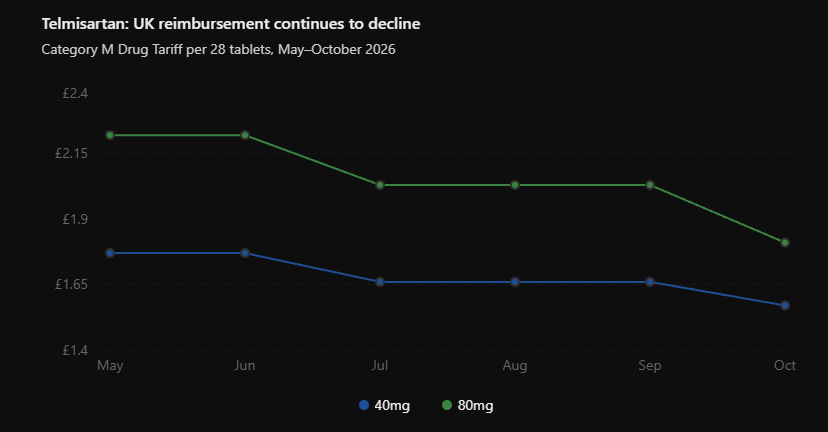
Figure 1. Category M Drug Tariff per 28 tablets, May–October 2026. Source: NHS Drug Tariff / supplied iEthico chart.
International supply pressure is increasing at the same time as the UK reimbursement environment is becoming less favourable.
Drug Tariff pricing reflects reimbursement arrangements and historic market conditions. International shortage notifications provide a different perspective, highlighting disruption and potential constraints across wider supply networks. When viewed independently, falling prices can create an impression of stability. When viewed alongside international shortage intelligence, that picture becomes more complicated.
Why the timing matters
Medicines supply disruption rarely develops uniformly across markets. A shortage may first emerge in one country, while neighbouring markets continue to receive sufficient stock. Existing inventory, different procurement arrangements, supplier relationships and national distribution structures can all influence how quickly disruption becomes visible.
This creates a period in which international supply conditions may be deteriorating while domestic availability and pricing remain relatively stable. For Telmisartan, that divergence is becoming increasingly visible.
The critical issue is the potential delay between emerging supply pressure and the point at which that pressure becomes visible in the UK market.
By the time shortages are reflected in domestic availability or acquisition costs, the opportunity to anticipate and manage disruption may already have narrowed. International signals provide an additional layer of visibility into developments that domestic pricing and availability data may not yet capture.
The commercial risk extends beyond future price increases
Supply warnings are often associated with the possibility of rising prices. But Telmisartan highlights a different commercial concern: what happens when the cost of maintaining reliable supply begins to increase while reimbursement continues to fall?
For pharmacies and wholesalers, alternative sourcing arrangements may become more expensive. Procurement costs may become less predictable. Available margins may narrow as supply becomes more difficult to secure. At the same time, reimbursement arrangements may continue to reflect earlier market conditions.
The risk is not simply that prices might eventually rise. It is that supply becomes more difficult to maintain before the market economics adjust.
What Telmisartan tells us about early warning
The Telmisartan data highlights a pattern that deserves greater attention across the pharmaceutical supply chain. International shortage notifications are accumulating. Some reported disruptions are expected to persist into 2027. UK reimbursement prices are continuing to decline.
These observations together describe a growing divergence between international supply conditions and domestic market signals. Understanding that relationship can support earlier procurement decisions, stronger contingency planning and more informed assessment of supplier exposure.
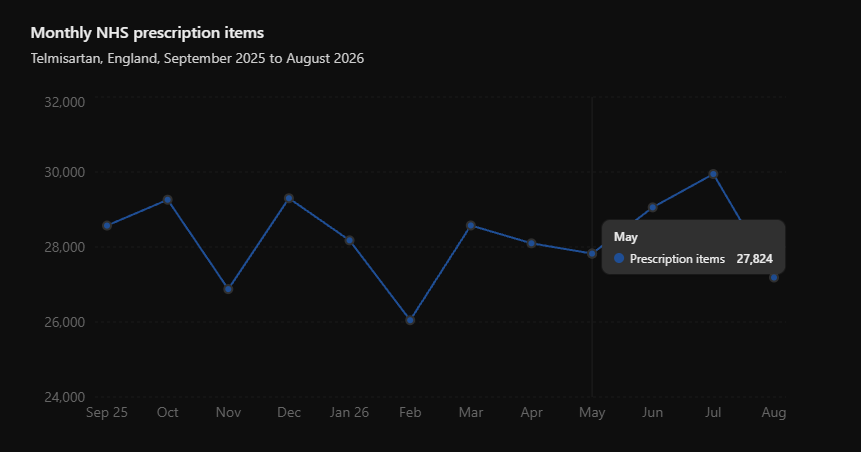
Figure 2. Monthly NHS England telmisartan prescription items, September 2025–August 2026. Broader telmisartan group, all strengths; source: OpenPrescribing / supplied chart.
Prescribing volumes for the broader telmisartan group remain relatively stable, averaging approximately 28,244 items per month over the 12-month period. This demand context reinforces the importance of identifying emerging supply pressure early.
The signal worth watching
Telmisartan illustrates why the earliest indicators of medicines supply pressure are not always found in the UK market itself. Sometimes they emerge through repeated shortage notifications elsewhere. Sometimes they become visible through increasingly long expected resolution periods. And sometimes they develop while domestic reimbursement prices are still moving downwards.
The value of supply intelligence lies in connecting these signals early enough to understand what they may mean for future availability.
Because the earliest warning of a supply problem may not be a rising price. It may be a falling price in a market where the underlying supply signals are moving in the opposite direction.
Sources
-
iEthico MedSupply Intelligence - International Telmisartan 40mg and 80mg supply alerts, May–October 2026.
-
NHS Drug Tariff, Part VIIIA, Category M - Telmisartan 40mg and 80mg, May–October 2026.
-
OpenPrescribing - NHS England telmisartan prescribing data, September 2025–August 2026.
-
iEthico MedSupply Intelligence - Subscriber reports, 21 and 28 April 2026.
-
iEthico concession prediction model - September 2026 Commercial Stress and October 2026 Shadow A3 outputs.